Blazing Star Liatris

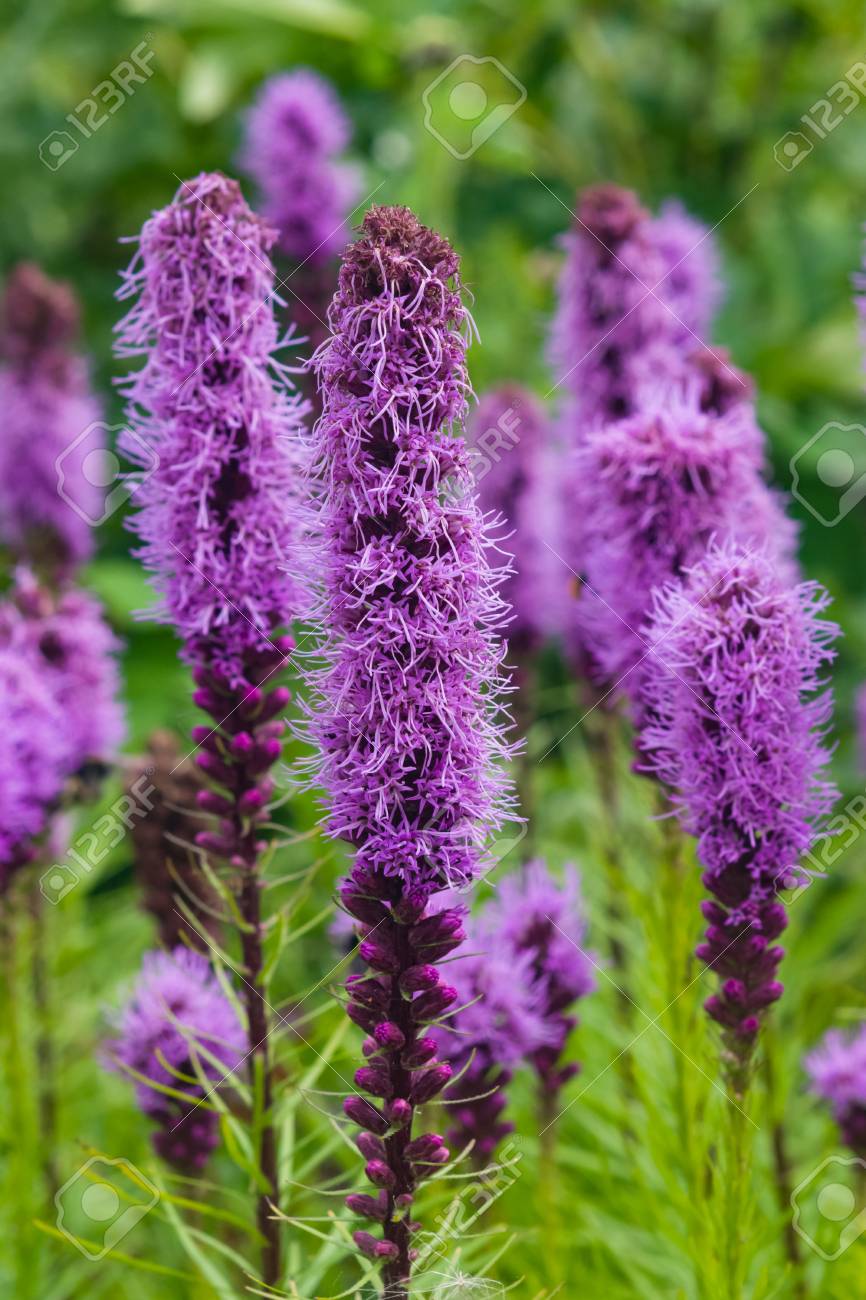
Call this tough, native plant Blazing Star or Gayfeather. Liatris is one of the great beauties of the American plains, and grows wild all the way from Canada to Mexico, making it a natural favorite for migrating wildlife, such as hummingbirds and butterflies.
Brundage, Stephanie Liatris spicata Liatris spicata (L.) Willd. Dense Blazing Star, Dense Gayfeather, Dense Liatris, Marsh Blazing Star, Marsh Gayfeather, Marsh Liatris (Aster Family) Synonym(s): USDA Symbol: USDA Native Status: CANDense gayfeather or marsh blazing star is an erect, slender reaching a height of 3-4 ft. The linear, grass-like leaves are clumped toward the base of the plant, but extend up the to the showy flower cluster. A tall of rayless, rose-purple (sometimes white), closely set flower heads. The purple, tufted flower heads are arranged in a long, dense blooming from the top down.The species name describes the elongated with its crowded, stalkless flower heads. The protruding styles give the flower an overall feathery appearance, hence its name, Dense Gayfeather.
Propagation Description: Scarified seeds may be sown outside in late fall or stored, stratified and sown the following spring. Some sources suggest spring seedlings will appear by simply laying the flowering stalk in an outdoor seedbed and covering with 1/2 in. Of soil in the faSeed Collection: Wait until the flower heads on the stalk have turned fluffy tan before collecting. Bring the stalks inside to air-dry then shake or brush the nutlets from the heads. Seeds can be stored with chaff in sealed, refrigerated containers.Seed Treatment: Scarification (lightly nick with knife) and stratification (3 months at 40 degrees).Commercially Avail: yes. Research LiteratureReslit 102 - (2000) M.
Baskin and C. BaskinReslit 106 - (1999) D. Gaussoin and R.
MastersReslit 415 - (1991) I. RohReslit 1052 - (2002) C.
Yes,' the make-up artist who has dumped her short boyfriend and is suddenly free to wear heels exclaims. The comfiest brand she has come across is Aldo.' Dark messiah of might and magic soul of the crone location. 'Aldo shoes are amazing! I make a note.
BoyleReslit 1224 - (2007) F. Schiappacasse, G.
Carrasco and F. CarrascoReslit 1358 - (1996) D.
Stimart and J. MatherReslit 1801 - (1993) Z. BorochovReslit 1898 - (1983) N. Zieslin and Z. GellerReslit 1899 - (1983) N. Zieslin and Z.
GellerReslit 1901 - (2006) G. SamboThis information was provided by the.
Phonetic Spelling LY-uh-tris spi-KAY-tuh DescriptionMarsh Blazing Star, in the daisy or aster family, is a clump-forming perennial that typically grows 3 to 6 feet tall. It is native to the eastern United States and is most often found in moist areas like marshes, bogs, or growing in meadows. In NC it is found in the coastal and Piedmont areas. The tall spikes of flowers bloom from the top-down, are showy and attract pollinators. The foliage is grass-like and grows in clumps.It prefers average to moist well-drained sandy loam soil with some organic matter in full sun to partial shade. It tolerates summer heat and humidity and this particular species does better in moist soils than some other Blazing Stars. The plant has corms with shallow fibrous roots and can produce new colonies from its corms though it most often propagates by seed.It is very attractive when planted in mass in a pollinator garden, rain garden, perennial borders, native plant gardens, or a cottage garden.Insects, Diseases, or Other Plant Problems: Sometimes taller stems can flop over and may require staking. Cultivars / Varieties:. 'Alba'White flowers.
'Kobold'. ‘Kobold Strain’Tags. Attributes: Genus: Liatris Species: spicata Family: Asteraceae Uses (Ethnobotany): Roots used medicinally by Native Americans Life Cycle: Perennial Recommended Propagation Strategy: Division Seed Country Or Region Of Origin: Central to Eastern United States and Eastern Canada Distribution: AL, AR, CT, DC, DE, FL, GA, IL, IN, KY, LA, MA, MD, MI, MO, MS, NC, NJ, NY, OH, PA, SC, TN, VA, WI, WV Fire Risk Rating: medium flammability Wildlife Value: Its flowers are attractive to butterflies, bees, and other pollinators. Larval forms of Schinia sanguinea (Liatris Flower Moth) feed on the flowers and seeds, and the larval form of Carmenta anthracipennis (Liatris Borer Moth) eat the stems. Goldfinches eat the seeds with relish.
Play Value: Wildlife Food Source Particularly Resistant To (Insects/Diseases/Other Problems): This plant is moderately resistant to damage from deer. Dimensions: Height: 3 ft. 6 in. Whole Plant Traits: Plant Type: Bulb Herb Native Plant Perennial Wildflower Woody Plant Leaf Characteristics: Deciduous Habit/Form: Clumping Erect Growth Rate: Medium Maintenance: Low. Cultural Conditions: Light: Full sun (6 or more hours of direct sunlight a day) Soil Texture: Clay High Organic Matter Loam (Silt) Sand Soil pH: Acid ( 6 inches Leaf Width.