The Thing Car
Paleontologist Kate Lloyd is invited by Dr. Sandor Halvorson to join his team who have found something extraordinary. Deep below the Arctic ice, they have found an alien spacecraft that has been there for perhaps 100,000 years. Not far from where the craft landed, they find the remains of the occupant. It's cut out of the ice and taken back to their camp but as the ice melts, the creature reanimates and not only begins to attack them but manages to infect them, with team members devolving into the alien creature. When it was announced that this was going into production, there was a level of confusion/curiosity regarding what exactly it would be: remake/reboot/sequel/prequel? Also, would it utilize prosthetic effects like the 1982 original, or would it go all out CGI splatter?
As it turns out, it's a combination of the former and the latter. The new 'The Thing' wants to have its cake and eat it too: you see, technically, it's a prequel but for some reason, the makers have molded it as kind of a remake as well. That's both clever and rather infuriating in equal measures. With regards to the effects, yes, they are CGI for the most part, but they look practical and are done well. Story-wise, with the exception of some additions, it hits the same beats as John Carpenter's original movie too. An alien vessel is discovered frozen in the Antarctic permafrost by a Norwegian research team.
Finding a mysterious life form, they bring it back to their research station. Even though there's no mention of an American in the original, the makers shoehorn one in here, clearly unconvinced that a movie comprised entirely of Europeans would sell. And likewise, it's a female – once again, you get the feeling they're not confident that an all male cast would sell this time round and are taking no chances. The American, a palaeontologist (Mary Elizabeth Winstead), is drafted into the equation by a member of the research group. Then they set about participating in a scientific study of the alien creature. Only problem is, it returns to life, and being a shape shifter that can replicate any living organism, starts to hide amongst the group, leading to lots of finger pointing, flame throwers, explosions and suspicion fueled arguments. Sounds rather familiar, right?
Universal Car Phone Stand Youtube Video: 3D design with Sketchup. Print this thing in PLA or ABS. The only thing you can do is try to get your hands on the car but you cannot cause a disturbance where the police are called. If you do get the car then he can do the same thing if he has a key.
Whereas the original 1982 movie was all about paranoia and the fear of the unknown - the alien hid among the human hosts, desperate to remain concealed at all costs, only showing itself when it felt its identity was compromised - it's distinctly not the case here. In this movie, the creature revels in revealing itself at every available opportunity.
With bells ringing. It screams and shrieks its presence to such an extent that all notions of a story based on the mistrust and doubt of an isolated group of characters goes out the window. What's the point in being a shape shifter if you're going to constantly give the game away?
Then there's another aspect that doesn't quite ring true: early on in the movie, the characters witness a violent helicopter crash. The logical thing would be to go out to investigate it and search for survivors but for some reason, they all choose to ignore it. Additionally, one can't help but wish the makers had called the movie by a different title; after all, if it's meant to be an official prequel to the 'The Thing', why call it the same name? It's not that it's bad movie; as remakes go, it's really rather good and executed with a lot of style.
Sequel-wise, it's up there with Psycho 2. As with the original, we get a scene where there's a 'big test' as Mary Elisabeth attempts to ascertain who's who in the group. In the original, Kurt Russell used blood samples; here, they go for an admittedly clever spin on that scene, while being totally different, adds a new aspect to the creature while also playing as some kind of homage. You might even conclude that since this is a prequel, then you must know the ending, right?
After all, we saw how it ended in the opening scenes of the original 1982 movie starring Kurt Russell. While they don't violate the events, they take the movie in a whole different direction but still shrewdly stick with the original time- line. Mary Elizabeth Winstead is very good in this. She doesn't strut around with a 'Look at me, I'm so gorgeous' expression; in fact she plays the role - sans make up, for the most part – with a level of icy, cool female conviction unseen in a movie about a creature from outer space since a little movie made in 1979 called 'Alien'. It can't be an accident that she reminds the viewer of the Ripley character played by Sigourney Weaver in the same movie and even possess a similarly unconventional beauty.
Based on this, it wouldn't be surprising if she ended up replacing Weaver in the inevitable reboot/remake etc. Of that franchise.
The John Carpenter original was rightly celebrated for its surreal effects, giving audiences something that was genuinely cutting edge and never seen before at the time. Happily, there is lot of utterly bizarre transformations going on here as well that will make your jaw drop: a guy's face splits open; two men fuse together and in an attempt to outdo the spider-head of the original, we see a monstrous four-legged creation stalking its prey.
While everything is 90% CGI, once again it's done in such a way that it almost homages the original. For the most part the effects here look similar to the 1982 movie, except they're done with a sheen that only CG could create. In conclusion, is it any good? It's not the disaster some snotty critics would have you believe. While it's not as good as John Carpenter's move (but then, what is?), it still honors the original while effectively and cleverly building the story that lead to the events in that movie. Yes, the aforementioned 'Thing' does shout and scream a bit too much, giving away its presence all too often, but that could easily be interpreted as a legacy of its inexperience with humans.
This is a prequel, after all. But don't worry - by the time Kurt Russell and pals come along, it will have learned its lesson.
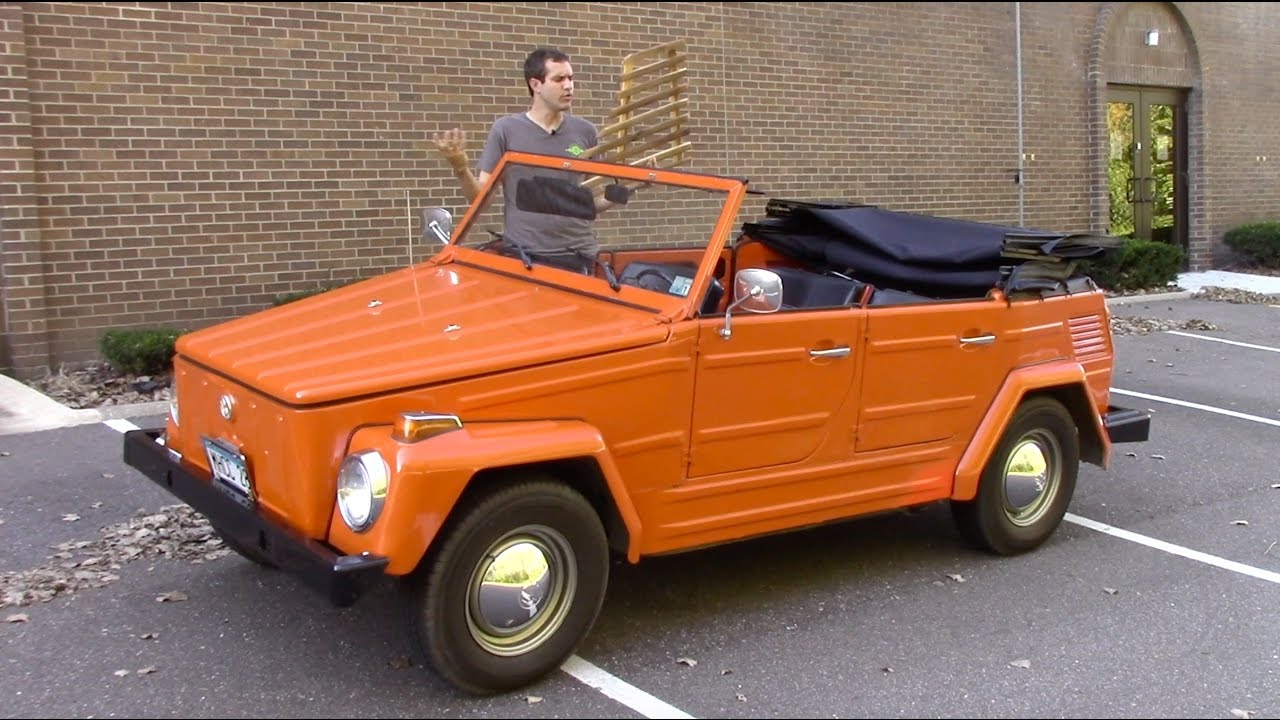
Looking at the picture, one might wonder, “What is that thing?” That thing is a Thing, a Volkswagen model called the Thing.It’s a goofy-looking vehicle that originated in the Nazi military that was known as a Kubelwagen. “Kubel” means “bucket,” so it would be a bucket wagon. It was sort of like a Jeep but bigger and with only rear-wheel drive. It had four removable doors, and the front and back doors could be exchanged. The rear seats could be folded down for extra cargo space, but it was one very basic set of wheels.The Thing looks like a kit car some kid assembled in his backyard after responding to an ad with a coupon in Popular Mechanics magazine. The sides look like corrugated aluminum. It’s called a convertible, as the top does come down, but as the owner stated, it is pretty much a two-person job.
It has side curtains, not glass windows and if you want to clean the inside, bring the hose over.“I’ve owned it for 25 or 30 years,” said Danville resident Don Andres, speaking of his 1973 VW Thing. He has always had a fondness for the Thing and even tried, unsuccessfully, to get his kids interested in one instead of a VW Bug. He thought it would be a great knock-about car and talked about the Thing frequently to others.“I mentioned it to one of the fellows I worked with who had relatives in Modesto. He came home from visiting these relatives and said, ‘I saw your Thing.’ ”Shortly thereafter, Andres was off to Modesto to see the vehicle and bought it for $3,000 (he thinks), which would be about $6,500 today. “Now I see them on the Internet for $10,000 to $20,000, depending on their condition.”Very little additional work was required by Andres after purchase.
The former owner, a mechanically inclined junk yard dealer, had it in good shape and had even chromed the engine. Andres did add a roll bar, improved the seating, lined it with carpet to reduce the road noise and bought glass aftermarket side windows.“I don’t think I have put another $1,000 in to it,” he stated. It was considered an off-road vehicle, but not in the same category as rugged four-wheel drive vehicles.
But the styling of the Thing, with the top down, the doors off and the windshield folded down, made a pretty good-looking dune buggy.The Thing was powered with VW’s air-cooled 1600 cc engine, producing 46 horsepower and teamed with a four-speed manual transmission. They were very slow on acceleration — zero to 60 mph almost could be measured accurately with a calendar rather than a stopwatch. There is minimum instrumentation with the Thing; in fact there is only one instrument consisting of a speedometer housing a gas gauge, that’s it. The glove box is just a hole in the dash with no door.Naturally, there is no power anything and the heater, an option, is gasoline-fueled, hooked directly to the fuel tank, which is located just in front of the driver on the fire wall. Why did Ralph Nader think the Thing was unsafe?
In 1974, they switched to a hot air system coming off the engine, but it wasn’t very effective in real cold situations.With such a basic vehicle, one might think it was dirt-cheap to buy, but no. The list price in 1973 for a new Thing was $3,150, about $1,000 more than the VW Bug or about $18,000 in today’s dollars. The VW Thing was imported to the U.S. Only in 1973 and 1974 and then the new safety standards came into play starting with the 1975 models. The vehicle was reclassified from a “utility” vehicle to a passenger car and among other things, the closeness of the one-piece windshield to the passenger was considered unsafe.Since the Thing was made from largely off-the-shelf parts at VW, maintenance and parts replacement are readily available.
There are a number of aftermarket parts suppliers that keep the prices at a reasonable level.Only three colors were available, Sunshine Yellow, like Andres’ vehicle, Pumpkin Orange and Blizzard White. There were 90,883 Things manufactured in Germany and Mexico from 1968 until 1983, with about 30,000 sold in the United States.
This has been a very fun car for Andres to own.“Wherever you go with it, people stop and look at it.”While this is not a show car, he had it at the Hot Summer Nights car show in Danville recently. It’s a vehicle that can bring back very happy memories.“One couple came over and said they dated and got engaged in one.”He is thinking that it may be time to sell it. Would it be the end of an era full of happy memories?
No, he tells me, he also has a show-car-quality 1974 Thing in his garage.Have an interesting vehicle? Contact David Krumboltz at MOBopoly@yahoo.com.
It was released in 16 Oct, 2007.Smersh is Russian for “Death to Spies” and was the name of a set of counterintelligence agencies formed in the Soviet Army during World War II. Death to Spies (Gold Edition) is a third-person stealth action.Death to Spies (Gold Edition) is developed by Haggard Games and published by 1C Company, 1C-SoftClub. Their mission was to secure the rear of the active Red Army by arresting traitors, deserters, spies and criminal cells. Death to spies gold edition.