Splatterhouse
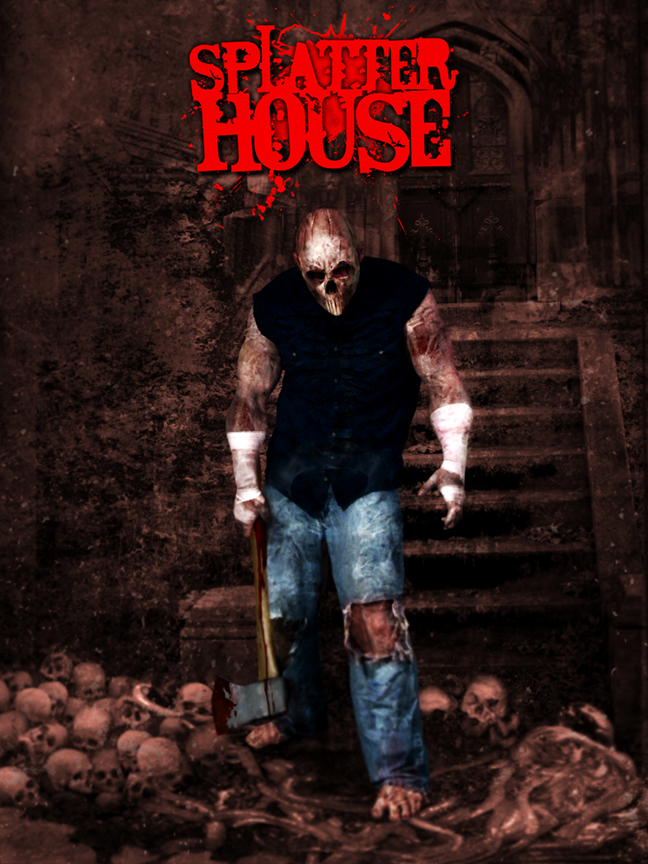
Splatterhouse development continued for a year under the new long-distance arrangement, with heavy crunch and overnight schedules. That brought the total cost to roughly $20 million before Namco. Alots of heart went it to this game. Alots of detail from the splatterhouse universe is here. As a fan of Splatterhouse I love it. It has a creepy atmosphere, a sense of exploration (which I like) and challenge. I love the touch with the mirrors in the mansion (thats where Im at so far). I feel like Im in the splatterhouse world. Well done my.
In 2005, Xbox 360 was new to stores, PlayStation 3 was around the corner, media giants Namco and Bandai had just merged, and Makoto Iwai took a job as a senior vice president at Namco Bandai’s newly joined U.S. Office.Iwai, a Sony veteran, says his mission was clear: to find a local hit for the new generation. The company had a stable of legacy franchises like Ridge Racer and Tekken from its studios in Japan, but the Western market was growing. Violent, edgy, Western-focused games like Grand Theft Auto were taking off, and Namco Bandai wanted a piece of that success.It tried a game based on the American anime series Afro Samurai.
It tried a reboot of in-house action series Dead to Rights. It tried the mythological adventure Enslaved. It tried a gravity shifting shooter called Inversion. And then there was Splatterhouse.A late-’80s gore-fest, the Splatterhouse series originally flickered to life in arcades.
Taking advantage of the slasher genre’s popularity, the game featured a Jason Voorhees-like masked hero named Rick splattering a variety of ghoulish creatures in a crude beat-’em-up.Since it was a brutal, M-rated franchise and Namco Bandai owned the IP, the publisher’s American branch was enthusiastic. “Resident Evil was a big success by Capcom,” says Iwai. “We sought similar success by using a well-known franchise. I thought that was a shortcut.”What came next involved finding an American development studio with a penchant for brawlers, a choice that would eventually haunt Namco Bandai. In retrospect, the casualties of Splatterhouse were significant: wasted development funds, a shuttered third-party studio and a newly opened first-party team — which then closed when Splatterhouse shipped. The circumstances were as messy as the blood-soaked game.“I learned a lot from Splatterhouse I wouldn’t wish on anybody else,” says Russell Schiffer, Namco Bandai’s senior director of technology, laughing as he speaks.
Splatterhouse (2010) concept art Bandai Namco Enter BottleRocketTo kick off development of the project in 2007, Namco Bandai chose BottleRocket Entertainment. The studio was staffed with many members of the team that had worked on Sony’s PlayStation 2 brawler The Mark of Kri, a critical darling known for an unusual targeting system where button command prompts appeared above enemy heads.“I knew Jay Beard, BottleRocket founder,” says Iwai. “There was a strong push from the studio side to use BottleRocket.
They were quite renowned.”. Splatterhouse (2010) concept art Bandai NamcoSigned to a deal, BottleRocket put approximately 35 people to work on Splatterhouse. It was one of two projects for the studio, coexisting alongside a game based on DC Comics’ Flash for publisher Brash Entertainment.The original ’80s Splatterhouse used a simple arcade hook, with Rick punching slimy ghouls and smashing monsters in the vein of a gory Altered Beast. Wooden boards and cleavers were the weapons of choice.
Splatterhouse, though, wasn’t a series known for depth.For the new game, Namco Bandai stuck to that idea. A design document set out development goals for traditional brawler combat and a visual style reminiscent of the old games, along with other nods to the originals.That wasn’t the plan BottleRocket followed, beginning a rift between the developer and publisher.“There was a big pull between what Namco wanted and what Jay Beard wanted,” says Scott Holty, who joined BottleRocket seven months into development as a senior designer.
“Those two things never really coincided. They were never in lockstep with what each side wanted with the game.”Many involved in the project say BottleRocket’s approach resembled its past work a little too closely.“They were really trying to shoehorn in that blue/red Mark of Kri targeting system, and that’s not what Namco wanted at all,” says former BottleRocket concept artist Dave Wilkins.Along with that, the character designs moved away from Splatterhouse’s typical selection of monsters.
Discover all 4 Pics 1 Word answers with 7 letters (For the year 2020) All solutions for you Click now and find all answers easy and comfortable! 4 PICS 1 WORD ANSWERS 7 LETTERS. Here you will find all solutions sorted alphabetically. IMAGE SOLUTIONS. 4 Pics 1 Word answers and cheats for 7 Letter words of the popular game for iOS and Android by developer LOTUM GmbH. Having trouble beating a level of 4 Pics 1 Word with 7 letters in the answer? 4 Pics 1 Word answers and cheats for 7 Letters words of the popular game for iOS and Android by developer LOTUM GmbH. Your answers in the game might be in a different order, so check the previous page if the answer below does not match the question on your level. 4 pics 1 word answers 7 letters.
In their place came designs that some on the art team found strange. This image contains sensitive or violent content Tap to display Splatterhouse concept art of a naked character with a TV on his head.
Bandai Namco“There was a guy with a TV set on his head, and it was plugged into his crotch. It wasn’t very Splatterhouse-like,” says Alvin Chung, brought on as an environment artist at BottleRocket. “The new designs were just kind of oddball.
I don’t even know how to describe it. From a video game perspective, they didn’t really read well. You couldn’t tell what it was.”These ideas strayed from Namco Bandai’s desired path.“They were basically supposed to work on Splatterhouse along with a design document of which we mutually agreed,” says Iwai.
“That part only showed when our staff visited with them. Right after Bandai Namco staff left their premises, they started doing a different thing, which was ordered by Jay.”“Every single time they’d deliver a milestone, Namco Bandai had complaints and issues with it. They kept reiterating they did not want Mark of Kri,” says Holty.In addition to the design not meeting Namco’s specifications, a variety of behind-the-scenes problems at BottleRocket created a development bottleneck. Progress slowed.“The big decision they made, which was a bad decision, was to use the Gamebryo game engine,” says Michael Seare, who began the project at BottleRocket as a physics programmer and later became lead engineer.
“From a technical standpoint, it is a horrible engine in that it’s not fast. When it comes down to pushing bits around, it was terrible.”In the art department, Chung came onto the project, joining a team composed mostly of recent graduates.“I don’t think they had produced anything for the PlayStation 3 before,” says Chung. “I remember coming in and working on one level, and they never understood how a normal map could make something look good. It was mind-blowing.”“ Splatterhouse from the BottleRocket side started off showing some really nice progress, and then it started to feel like BottleRocket producers were showing us, ‘Look, we reworked the art on this character — again,’” says Schiffer.
“That started sending up red flags about ‘gosh, why aren’t you showing us more gameplay progress?’. We would see gameplay along the way, of course, but after so many of those, and it was several of them — other people, not me; the people on the business side — began to get nervous.
When they looked into it deeper, they determined progress was not at the rate we wanted it to be.”Wilkins saw all of this as a management issue. “You had lead designers and designers who were doing really solid, awesome work, and then the shot-callers at the top would be like, ‘No, I want to see this,’” he says. “We’d say, ‘Yeah, but it’s Namco’s game. They’re paying to keep the lights on.’”. Splatterhouse (2010) concept art Bandai Namco”It’s always difficult in that position because you want to push for your creative voice, but at the same time, you’re trying to represent the company you’re working for,” says Holty.
“Then you also realize that Namco is the one that’s paying the company.”BottleRocket’s team, with Jay Beard continuing with more or less the same vision, progressed on Splatterhouse for 18 to 24 months. The Flash continued as well, keeping BottleRocket working at capacity. Then, in November 2008, Brash Entertainment shuttered, which meant that BottleRocket’s development on The Flash. That left BottleRocket with Splatterhouse and a second team without work.Those we spoke to for this story gave conflicting answers on the fate of the Flash developers.
Some said those team members stayed on and helped with Splatterhouse. Others said BottleRocket kept working on The Flash, with hopes of securing another publisher. Another person said they were let go soon after Brash folded. Multiple sources reported feeling surprised, though, that the company kept spending at this time, noting as an example that BottleRocket built an in-house theater room despite having only one project in development.Namco Bandai higher-ups were still displeased with BottleRocket’s lack of progress. “When I saw it, it was a collection of features and pieces but with no real metagame behind it, and the tools were so poorly implemented that no design was coming,” says David Robinson, Namco Bandai’s executive producer on Splatterhouse.“I went down there and started meeting with the guys, trying to get my own feel for it,” says Roger Hector, then the senior vice president of product development at Namco Bandai. “To make a long story short, everyone shook hands and said, ‘Yeah, we’re on it.
It’s all good.’ When the deliveries were due and the stuff they were supposed to be doing wasn’t happening, I had to make a recommendation into Namco and say, ‘Hey, this doesn’t look like it’s going to look very well.’”(BottleRocket founder Jay Beard didn’t respond to multiple requests for comment for this story.)With quality issues continuing, Namco Bandai made the decision to pull Splatterhouse from BottleRocket in February 2009. Splatterhouse (2010) concept art Bandai Namco Hauling awayWhen the news broke to the gaming press, an unnamed Namco Bandai representative, “At this time, we are not ready to discuss specific development details about the game and wish BottleRocket the best of luck in their future endeavors.”That same day, Namco Bandai brought a U-Haul truck to BottleRocket’s offices to collect development kits. Some on the team had no advance notice.“It was just a normal workday,” says Holty. “Everyone goes to work and there’s a bunch of moving trucks in front of the company. Everyone’s like, ‘What’s going on?’”Former Namco Bandai associate producer Dan Tovar, who had been with the project from its earliest point, recalls that day: “What followed was one of the most unpleasant experiences I have had to date in my professional career.” Tovar continues, “There were grown men crying. ‘Hellish’ doesn’t quite summarize it.”.
“We didn’t cancel the game. We fired the management.”“They pulled us all inside and said, ‘That paycheck you got today? This is your last check, because we don’t have any money in the bank,’” says Dave Wilkins.Not all was lost for some members of the BottleRocket team, though. During the dev kit retrieval, Namco Bandai management handed out some business cards. Splatterhouse wasn’t canceled — development was to continue, but now under the banner of Namco Bandai.“We think it was Jay who misled the studio,” adds Iwai. “Some of the artists were really good. Some of the game designers, too.”“The management spent the money; the kids didn’t,” says Robinson.
“We didn’t cancel the game. We fired the management.”A month after the decision, Iwai stated Namco Bandai’s position publicly. BottleRocket lost Splatterhouse because of a “performance issue” with the team, Iwai said in, vaguely describing the internal problems.Two days later, BottleRocket sent out: “ Splatterhouse had been in development for over eighteen months and up to having the title taken away from us we had not missed any contractually defined milestones.
So either there were no performance issues during that time frame or Namco’s management of the title was inept.”Asked now about his comments, Iwai says, “I knew I couldn’t go into details. I know people tend to blame the publisher for canceling a project, but that’s not the case always. It was purely a performance issue.”. Splatterhouse (2010) concept art Bandai Namco To CarlsbadIn an attempt to continue cohesively, Namco Bandai hired a number of BottleRocket’s developers, forming a studio in Carlsbad, California, near BottleRocket’s San Diego location. The group would work together with Namco Bandai’s studio in Santa Clara, California, the team responsible for 2009’s Afro Samurai.Splatterhouse sat in limbo for three months as Namco Bandai formed the new Carlsbad studio, acquired equipment and settled in. The distance between Carlsbad and Santa Clara — more than 400 miles — created complications.“We were flying back and forth quite a bit just so we could maintain continuity and have team meetings,” says Holty. “Plus, in the beginning, I had to go and teach all the tools to all the designers and artists, and get that whole team up to speed.”The new Carlsbad group needed to put together a full team.
Roger Hector and others pulled a number of BottleRocket’s key members into the fold, including physics programmer Michael Seare, whom Hector tried to hire.“I’m not necessarily proud of what I did here, but at the time when Hector approached me, I had accepted an offer from Rockstar San Diego,” says Seare. “I was going to start working on a Monday. Hector contacted me twice over that weekend to discuss a number of details about establishing the Carlsbad studio, and I said yeah, I’ll do it.
That meant going into work at Rockstar on Monday and quitting.”Namco Bandai sought to keep the budget in check — having already paid for a year of development time — which meant tight schedules and heavy pressure.“It wasn’t like, ‘You have a year and a half to finish this game,’” says Wilkins. “It’s like, ‘Let’s see where you are in three months, and we might decide to kill it and we might not.’ So we busted our humps for three months to the milestone, and then, ‘It’s looking pretty good. Keep going.’”.

This image contains sensitive or violent content Tap to display Splatterhouse (2010) concept art Bandai Namco Late-night salvage jobThe two teams began parsing what they could keep. BottleRocket hadn’t completed a usable amount of work. “There was the rough shell of a bunch of levels, but you could not play the whole thing front to back,” says Tovar. “Huge amounts of systems were not complete, and most importantly, it just wasn’t fun.” Saving any of that work meant reducing costs and time. Robinson formed a plan.“The only way we could ship was if we created days without cutting features,” says Robinson. “How do you create days? Well, we had close to 90 street days of bugs, but only 62 days of bug days to cure.
We were going to blast through this schedule in two, three months. What we’ll do is, I’ll stay up all night, every night. I’ll change the whole team schedules so that testing happens while everyone is asleep.“Everyone on the team drew a straw,” Robinson continues. “That straw meant you had to fix any bug in the game, and you had to be on call. It was close to 20 of us. I would show up at 4, 5 o’clock, and I would produce my other games until 6 or 7. Everyone would submit their last overnight build and I would play until the morning.
As soon as I hit a bug, I’d call up whoever was in charge that day, they would run in, fix it, and I would start the play cycle again. We gained 22 days back.””There was an occasion, a few times, in three days I think I slept for three hours,” Chung recalls. “I remember just sleeping on the floor and taking a break.”. Some work from the BottleRocket days gave the team a reprieve during those long nights.“There was this weird concept art, back before we started, of this weird zombie-looking dude with a car battery strapped to his ass, and he was wearing a diaper,” says Wilkins.
“When we would be grinding late hours, waiting on pizza to come and it’s 2 a.m. To get a build done and everybody’s dragging ass, we would send that email out with that picture and ‘never forget,’ and you could just hear, all across the studio, everyone would just lose their mind laughing.”Keeping some of BottleRocket’s work created problems as well.
To save time, Rick’s original animation rig remained. “You can see in the final game he’s got a really short bicep and his head’s a little bit big, and it’s all because we had to make that skeleton work,” says Wilkins.Splatterhouse also gained a cel-shaded art style, similar to what the internal team at Namco Bandai did with Afro Samurai. “At that time with Afro, we kind of led the industry in that research. We felt we could really push this agenda of ‘we own this art style,’” says Robinson.With added graphical fidelity, Splatterhouse also took on a new level of gore. Rick could grab his opponents and perform grisly fatalities, ripping off heads and arms with blood spurting everywhere. Some at Namco Bandai Japan found the gore off-putting.“From Bandai or Namco’s management perspective, it might be too much,” says Iwai.
“But I said, ‘You guys want to achieve global success. The M-rated games market is such a huge market. If we are capable of going into the market, why don’t we?’ Some people didn’t like the M rating in the beginning, but somehow I was able to shut the noise down.”. Powermonger manual.
Splatterhouse (2010) artwork Bandai Namco The $20 million bustSplatterhouse development continued for a year under the new long-distance arrangement, with heavy crunch and overnight schedules. That brought the total cost to roughly $20 million before Namco Bandai released Splatterhouse on Nov. 23, 2010.Asked if Splatterhouse did well financially, Iwai simply replies, “Unfortunately, not really.”“We missed a critical Halloween launch that many thought would have made a huge difference in the commercial success,” says Tovar.On Nov. 1, weeks before the game shipped, the Carlsbad studio closed — except for a single employee.
Michael Seare stayed on as the lone staffer, waiting for final quality assurance approval for the PlayStation 3 version. “We did the best we could. What you got in the box at the end was 75 percent of what we going for.”“We hadn’t heard from Sony,” he says. “I think Namco realized it, because Hector called me again and asked me if I would remain on staff — just me — and if there are any last-minute bugs, fix and resubmit to Sony. I’ve been through this before, and I knew in the past that it took more than one engineer to fix these bugs. Sometimes there were design issues, and I was petrified. But fortunately, a couple of days after talking to Roger, Sony came back and accepted.
I was on staff for maybe a week longer than the rest of the crew.”Looking back, those speaking for this story share fond memories of the team around them, forming a positive outlook on the end product.“I don’t feel ashamed of it all, but I can’t look back on it without saying, ‘Boy, if we just had a little bit more time, we could have taken it up a notch,’” says Hector.“Even though it’s probably the lowest-rated game I worked on, in retrospect, when I think about its production, because of the limited resources, it felt like we built a tight camaraderie,” says Chung. “Everyone was proud to finish it considering the circumstances.”“We did the best we could,” says Wilkins. “What you got in the box at the end was 75 percent of what we going for. I wouldn’t trade that experience at all, even the BottleRocket days. I met some lifelong friends there. Creatively, we were surrounded by some of the most talented guys and gals I ever worked with to this day.”“That game just didn’t have the tools to be polished the way it needed to be polished,” says Robinson. “Like most great opportunities, it just simply ran out of money.”As of this story posting, Splatterhouse sits at a 59 Metacritic score on PlayStation 3, and a 62 on Xbox 360.
Yet for Roger Hector, Splatterhouse represents the unpredictability and turmoil of game design, and for him, that’s a sign of success.“Every game design project, if it doesn’t have troubles, it’s not trying hard enough,” says Hector.
This game features, as did the original, a young man named Rick who must venture into an old mansion to save his girlfriend who has been taken by the deranged Dr. He is basically bleeding and left for dead when we meet poor Rick, but he is offered assistance by a mask that offers him the power to save his girl. Well he puts on the mask and grows into a super sized hulking dude that can tear his opponents limb from limb. Along your quest you will also be able to use pipes, meat cleavers, shotguns, and chainsaws to get you through the strange mansion and at times other locales. For the most part the game is fun, just needs work as it seems the makers of this game rushed its release or something. Along with the fun mayhem you also have to go through some very long loading times and a few glitches that will have you turning off your video gaming console.
However, should they make a sequel I think they can do what the Uncharted franchise did. The first one was good, but very flawed, then the second one came out and it quite frankly seemed to read all my complaints and improved upon all of them. They can do that with this one too, as it is fun and simple enough to master as you simply push a couple of buttons and follow the prompts to pummel you opponents into a gooey mess. The monsters you face look cool, though they do repeat a bit to much near the end with nothing really new coming at you the last few levels.
My favorite level had to be the fun house level as it was just really fun and had the most interesting level design. I also enjoyed the inclusion of many H.P. Lovecraft references throughout the game such as Dr. Seeing the wickerman was cool to. If the makers had only polished this one a bit more I would have given it a higher score, however as it was it was a fun little splatter filled game.